Most leadership thinking starts from the same premise: effectiveness is a function of ability. The assumption is that if leaders accumulate enough knowledge, skills, and tools, effectiveness follows.
This logic made sense when information and analysis were scarce. Leaders were often limited by what they could know, calculate, or structure.
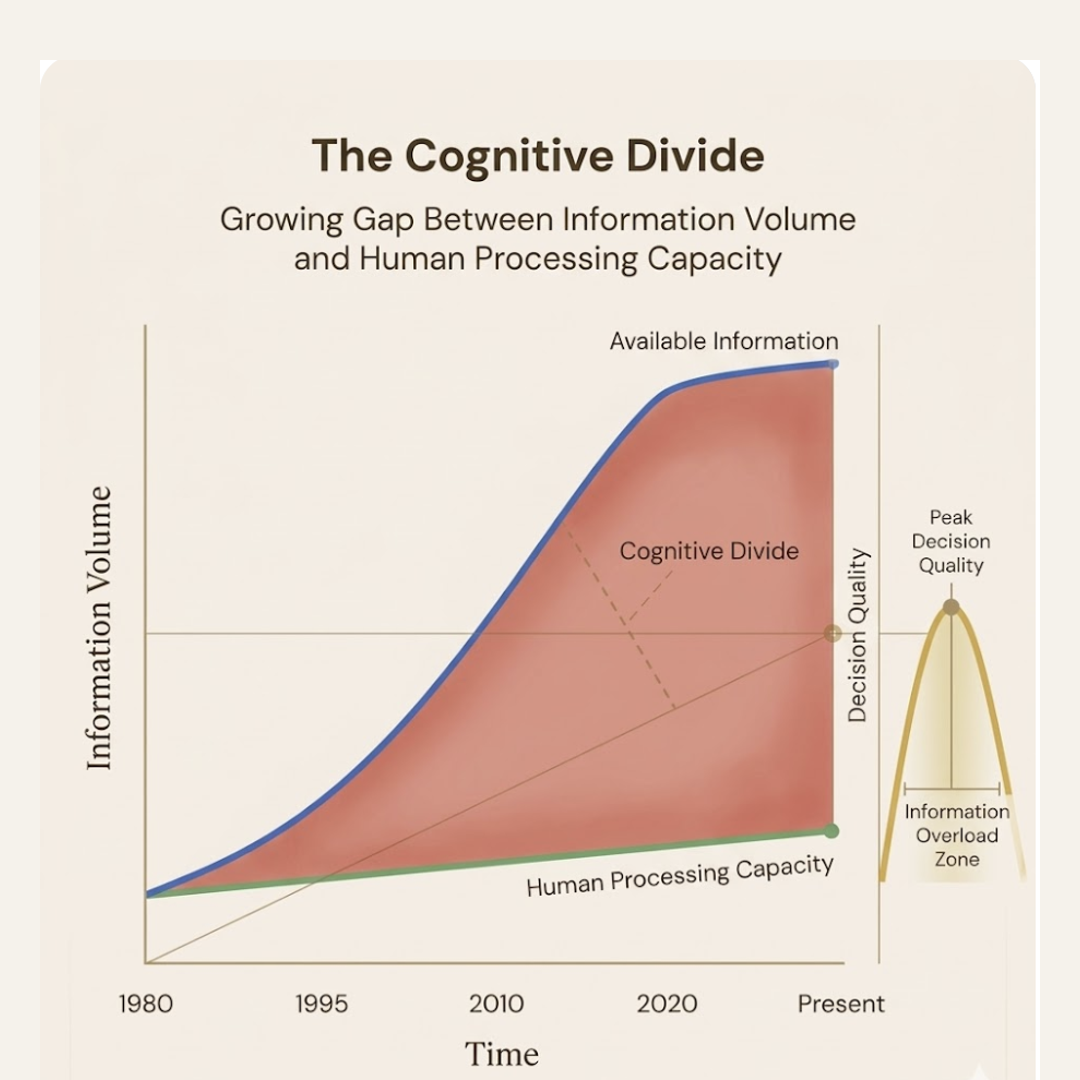
That equation has changed. The amount of "ability" available to leaders has exploded. Analysis, research, summaries, and recommendations are increasingly available on demand. The tools that once separated strong operators from average ones are becoming widely accessible.
That creates a different constraint.
Machines can produce answers and generate options. They cannot decide which ones matter. They cannot supply conviction.
Which means leadership effectiveness shifts away from pure capability and toward something else: access.
Axis = Access
In the Axis work, we identify the point where a leader can consistently access the four dimensions of leadership — Strategy, Systems, Humanity, and Authenticity — and move between them fluidly as the situation requires. That center is where human judgment and conviction come from. Everything else is input.
When leaders operate close to that center, decisions clarify. Trade-offs become easier to see. People understand the direction.
When leaders drift away from it, the typical response is to compensate with more capability: more analysis, more process, more activity. When those things are instantly available, the loop tightens. Leaders don't run out of answers — they drown in them.
That approach can work for a while, but it becomes harder to sustain as the environment gets faster and noisier.
In a world where intelligence is abundant, the advantage shifts to leaders who can reliably access their full capacity.
AI can make a leader faster. It can't make them whole.
AI didn't raise the bar. It made the bar irrelevant.
The ones who know where they stand will be fine. The rest will just have better tools for going in circles.