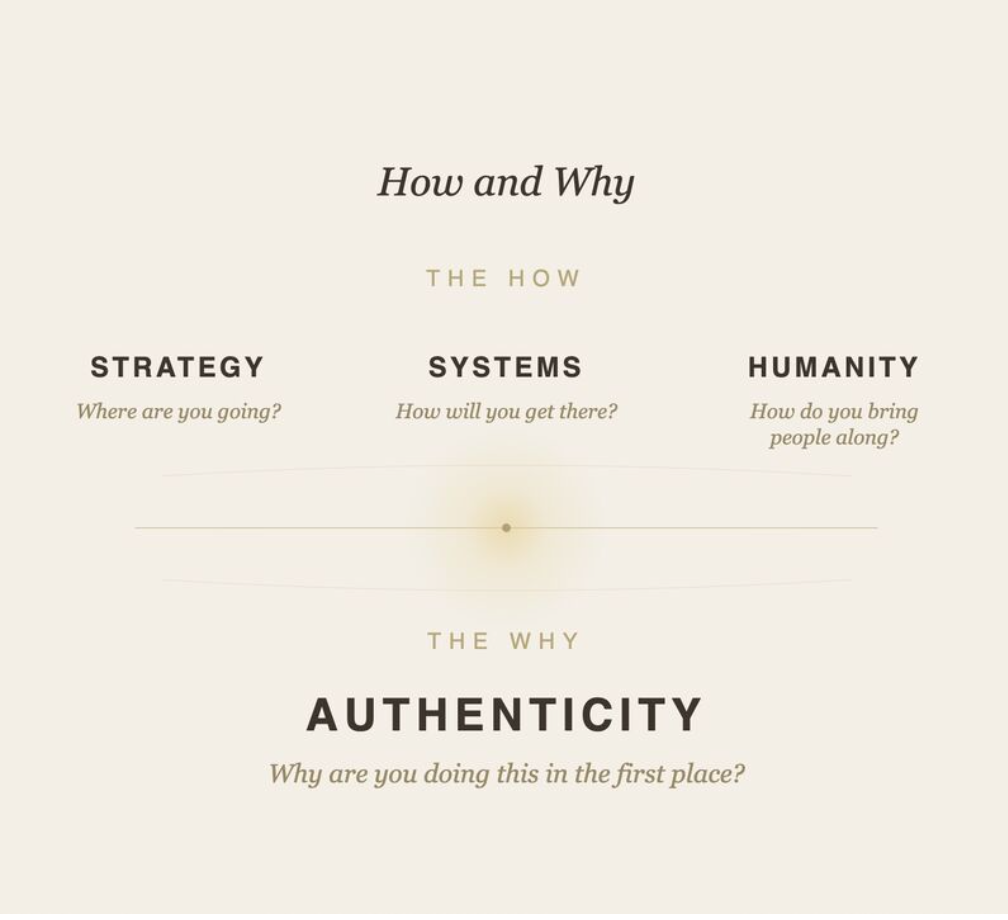
Most leadership frameworks are built around versions of the same question. How do you set direction? How do you build the organization? How do you bring people along? How do you communicate, decide, develop, deliver?
All real questions. All necessary. All variations of how.
But notice what's missing.
The actual why. Why are you leading this? Why this direction, why now, why you? Do you actually believe in it?
It sounds soft. It isn't. It's foundational — the question that makes everything above worth doing in the first place. Otherwise, everything is effort for no reason at all.
Strategy without it reads as a deck. Systems without it reads as bureaucracy. The relational work without it reads as performance. The individual capacities still function — you can still see them operating in the room — but they stop resolving into a single motion. The leader becomes a collection of competencies instead of a center of gravity. People around them feel it before anyone says it.
Coherence isn't a fifth capacity to add to the list. It's what happens when the why is intact underneath the how.
That's also what AI can't reach. A machine can run a process, draft a strategy, simulate empathy convincingly enough to pass. What it can't do is hold the consonance between belief and action that lets a room recognize a leader as real. Not because the technology isn't sophisticated enough — because there's nothing underneath it to be consonant with.
The strongest leaders aren't the ones who score highest across dimensions. They're the ones whose dimensions resolve into the same motion — especially under pressure.
That motion has a source. And the source is a question almost nobody is structurally asking.