If you use AI to write your client deliverables, you've probably noticed an uncomfortable truth: the initial output usually reads like premium cardboard.
It's smooth. It's grammatically flawless. It uses all the right corporate buzzwords. And it is completely devoid of the sharp, intuitive friction that makes a client pay a premium fee.
When I talk to elite consultants and executive coaches about AI, the consensus is often a weary skepticism. They worry that outsourcing synthesis to an LLM dilutes their proprietary methodology. They aren't wrong. If you give an AI a raw transcript and run it through a diagnostic rubric, it will default to the most generic, lowest-common-denominator interpretation possible.
But over the past year, I've been refining a hybrid human–AI workflow that produces deeply customized, high-register diagnostic deliverables in a fraction of the time — while actually sharpening the analytical edge.
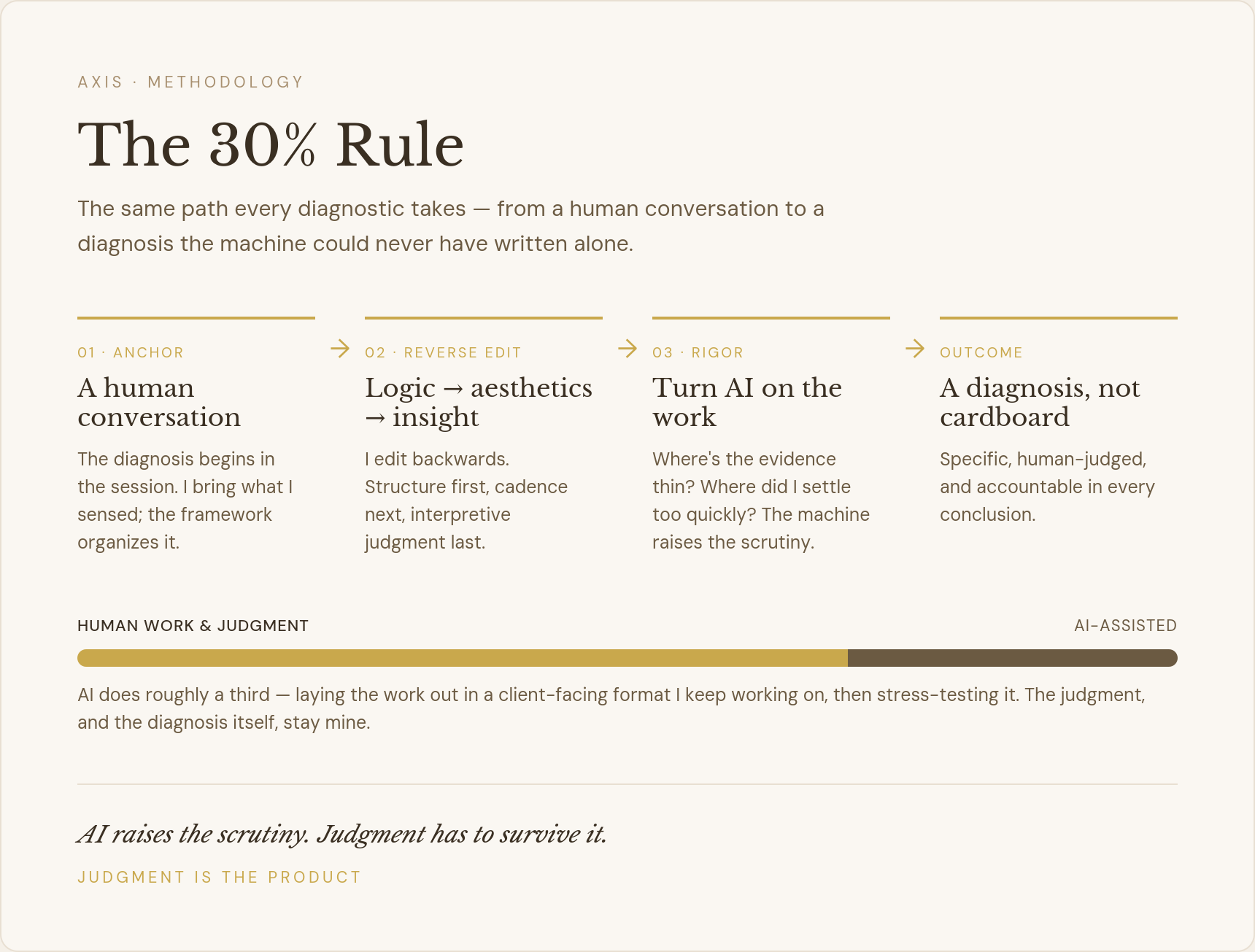
The secret isn't getting the AI to do 100% of the work. It's the opposite: keeping the machine to about a third of it. I call it the 30% Rule. The AI does roughly thirty percent — the first-draft assembly, and later the stress-testing. The other seventy — the judgment — stays mine. And it all runs through a precise, three-pass reverse pipeline.
Here is the exact blueprint I use to turn raw client data into a high-value diagnostic prelude.
Step 1: Anchor the Machine
Before the AI touches a single sentence, the real diagnostic work has already begun.
Everything emerges from an actual human interaction in my client sessions. I'm listening not only to what a client says, but to where they hesitate, contradict themselves, become unusually precise, lose conviction, or reveal something more important than the answer they intended to give. I ask the questions, read my clients, and decide what matters.
I don't feed the AI raw, noisy transcripts. Instead, I give it two things.
My raw impressions: the psychological undercurrents, behavioral red flags, contradictions, and breakthroughs I uniquely sensed in the session as a human practitioner.
Curated transcript notes: text I've already sifted — expanding on the critical diagnostic areas and aggressively cutting the administrative or conversational debris. Everything is anonymized before it reaches the machine: no names, no identifying details, nothing a client hasn't agreed to.
Both are forced to read against my framework and rubric. This keeps the AI from hallucinating or chasing irrelevant conversational rabbits. The machine handles the heavy lifting of structural assembly, but a human thesis drives the extraction from word one.
Step 2: The Three-Pass Reverse Editorial Pipeline
When the AI hands back the initial draft, it enters my editing pipeline. While most people edit for "style" first, I do the exact opposite. I work backwards: logic → aesthetics → insight.
Pass 1: Structural Calibration (Logic and Mapping)
This is the foundational pass. AI can understand context, but it doesn't reliably know which context is diagnostically decisive. If a client uses the word "people," the AI may dump it into a relational bucket — even when the context was a cold, strategic talent trade-off.
The human move: I audit the structural pillars. If the AI mismapped a client's behavior to the wrong dimension of my framework, I reset the boundaries by hand. The logic has to be locked before anything else happens.
Pass 2: Stylistic Harmonization (Rhythm and Cadence)
Once the framework is aligned, I strip away the "AI texture." Left to its own devices, AI prose oscillates between dense corporate-speak and overly enthusiastic coaching platitudes. Even when it can imitate rhythm, it rarely knows which rhythm belongs to this person, this diagnosis, this particular moment.
The human move: I bring in the cadences of elite human speech. I cut the fluff, tighten the transitions, and make sure the prose carries a distinctive, clinical weight.
Pass 3: Interpretive Judgment (Sharpening the Analytical Edge)
This is where I earn my fee. It's the stage where you take a perfectly logical, beautifully written sentence and turn it into a confrontation with reality.
The human move: AI can summarize a pattern, identify a contradiction, and propose an interpretation. What it cannot reliably do is decide whether that contradiction is truly meaningful, how much weight it should carry, or how it fits into the larger shape of a person's leadership.
That judgment — which contradiction matters, and how much — is the work only a human can do.
The Takeaway: Judgment Is the Product
By the time I reach that final pass, the manual labor of structural alignment and copyediting is largely out of the way. My mind is free to inhabit the interpretive lens and sharpen the diagnostic knife.
But the AI's role doesn't end with generating the draft. I also use it to challenge the work itself. I ask where the evidence is thin, where the language overreaches, where one interpretation conflicts with another, and where I may have settled too quickly on an answer.
This is the part of the process that matters most to me. Used properly, AI doesn't lower the standard of judgment. It raises the amount of scrutiny that judgment has to survive. The machine doesn't decide what's true. It makes it harder for me to accept an interpretation before it has earned its place.
If the machine is doing almost all of it and you're barely touching the draft, it's quietly co-facilitating your methodology — running your practice instead of assisting it. If you're rebuilding everything from scratch, it isn't saving you enough time to be worth it. Somewhere around a third is the band where the machine earns its place without ever touching the diagnosis.
Inside that band, you aren't being replaced by technology. You're using it to remove the "blank page tax," to challenge your own thinking, and to spend your creative energy exactly where it belongs: on the insights your clients can't find anywhere else.
AI never interviewed the client. It never heard the pause before an answer, noticed where conviction disappeared, or decided which contradiction mattered. It helped me organize, test, challenge, and refine the work. But every conclusion began in a human interaction, passed through human judgment, and remains entirely my responsibility.
The Cumulative Arc: Scaling Insight Across Multi-Session Diagnostics
The 30% Rule matters even more when you operate a multi-session diagnostic model.
In my practice, progress deliverables are built cumulatively. I don't wait until the final day to drop a 70-page report on a client's desk. Each session generates an intermediate directional anchor — a progress deliverable that captures the territory we've explored and flags early hypotheses for the next session to test.
This is another place AI falls short. It can retain and compare large amounts of material, but it doesn't experience a human being's evolving arc over weeks or months. It doesn't remember the exact defensive posture a client held in session one the way I do, or how their energy shifted when we finally cracked open a core blind spot in session three.
When I run that edit pass on a cumulative deliverable, I'm pulling the through-lines from the entire client experience by hand. Alignment can't be retrofitted at the end of a project.
By bringing the client into the diagnostic substrate step by step, you foster a deep, gradual self-recognition. They see their own behavior reflected back accurately and with clinical precision, so that by the time the final diagnostic and its action protocols arrive, there's very little friction. They don't feel judged by an external report card; they feel deeply seen by a narrative they helped build.
The result is that the final recommendations aren't just theoretically sound. They're already true to the client — and therefore immediately actionable.
That is the difference between cardboard and a diagnosis.